The largest journalist organization in the non-aligned world
Indian Federation of Working Journalists (IFWJ)
Founded in New Delhi on 28 October 1950. Independent India's first trade union of media persons, the IFWJ has now over 30,000 primary and associate members, working for electronic media, news agencies and 1,260 journals of 17 languages in 35 states and Union Territories. Overseas Indians, employed in other continents, are among its primary members. The IFWJ's fraternal organisations in the media world are the National Federation of Newspaper Employees (N.F.N.E., Kolkata) and the National Confederation of Newspaper and News Agencies' Employees Organizations (Mumbai).
As the only professional body of working journalists, having its branches in every city, town and publication centre of India, the IFWJ's regional and territorial units have set up press clubs, press academies', reference libraries, training institutes and study circles. They publish professional journals and engage in activities like media researches, trade union struggles, human right campaigns, environmental protection and anti-war movements.
The IFWJ is actively involved in the worldwide journalist movement. It has bilateral relations with over 47 national unions of the world. IFWJ members partake in the activities of International Labour Organization (I.L.O., Geneva) and the UNESCO's International Programmed for Development of Communication (I.P.D.C., Paris). It is affiliated to the Confederation of Asian Journalist Unions, Colombo. IFWJ president is also the chairman of this confederation. In recent years hundreds of IFWJ members have been to several countries in Latin America, Europe, the Afro-Asian region and the United States for conferences and training.
At the instance of the first statutory Press Commission in 1954, the Union and State Governments recognized the IFWJ as the representative body of working journalists for official purposes. A judicial scrutiny of IFWJ membership in 1977 reconfirmed its representative character. The IFWJ nominees are included in various official committees for media and labour matters like the wage boards, Press Council, accreditation committees, press consultative committees and overseas delegations.
The IFWJ is headed by its president, elected in a nationwide direct voting by thousands of its primary members every three years. The President is assisted by a Working Committee which has a Secretary-General, four vice-presidents, six secretaries, a treasurer and 17 members of executive, chosen at the trivial plenary session by hundreds of its National Council members by a system of single transferable vote.
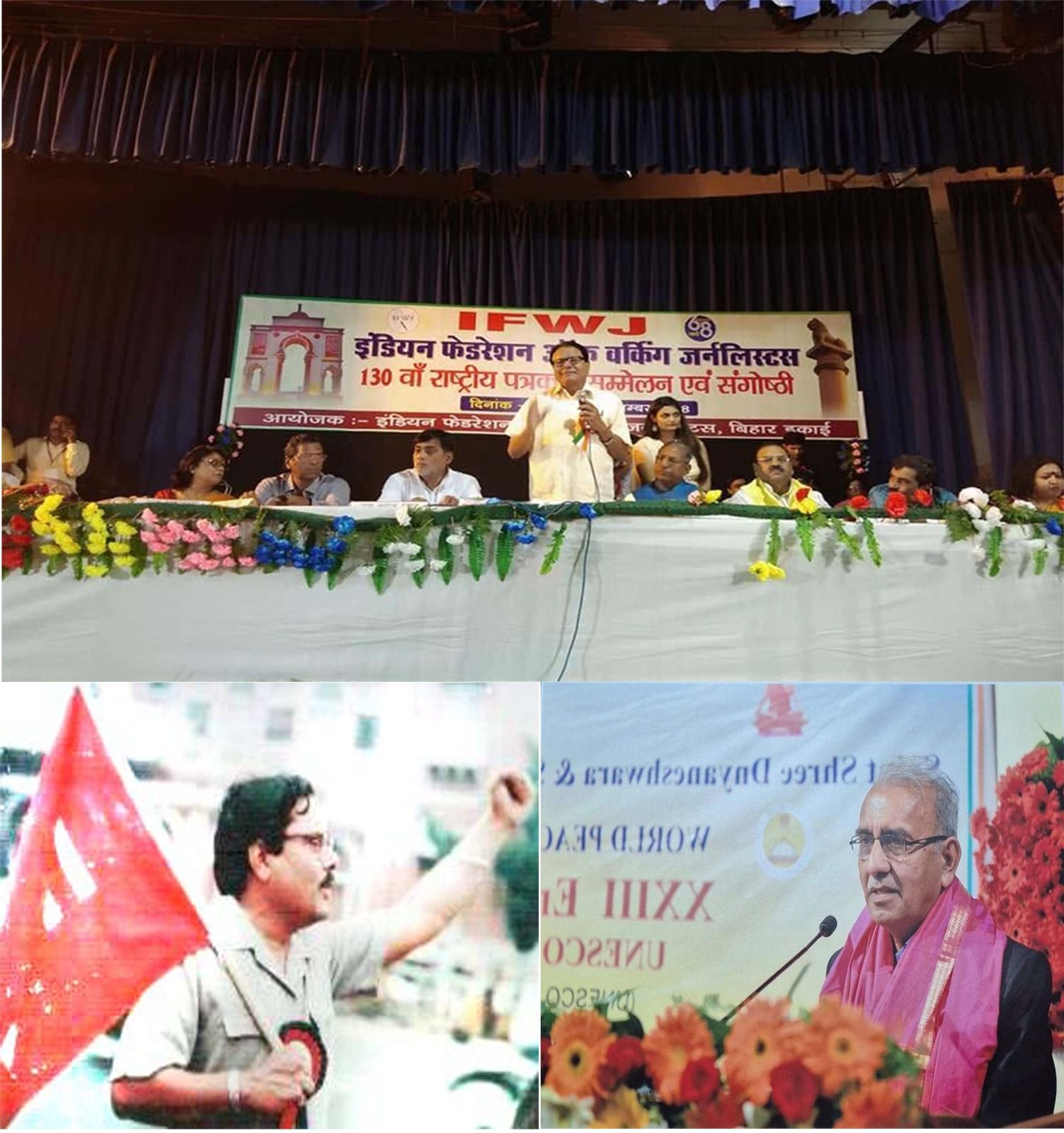
Persistent agitations by the IFWJ during the past 75 years resulted in several labour gains like the enactment of India's first-ever parliamentary legislation in 1956, fixing regular hours of work, improving other conditions of service and wage scales and many successful legal battles. Creation of two Press Commissions (1954 and 1980), periodic wage revisions since 1959 and formation of statutory Press Council are other IFWJ achievements. Peace march on Mahatma Gandhi's birth anniversary day at violence-rocked Amritsar town (Punjab, 1990), solidarity march at Lal Chauk (Srinagar, Kashmir), National Council sessions at Jaisalmer, Guwahati, Kurukshetra, Dharmshala (HP), Mount Abu, Cuttack, Ayodhya, Kanya Kumari and Rameswaram are some of the highlights of IFWJ's recent action programmers.
Presently the IFWJ has, as its 17th President, Gopal Misra, a veteran journalist, who started his three-year term in 2026. His distinguished predecessors included Dr. K Vikram Rao of The Times of India, late M. Chalapathi Rau, editor of Lucknow's National Herald, late Pothan Joseph, editor of the daily Dawn and Bangalore's Deccan Herald, late Adhir C. Bannerjee of Kolkata, late T. R. Ramaswami, editor of Chennai daily Makkal Kural, and Late Pandit Banarasidas Chaturvedi of U.P.